


Advancing lives: It’s not one lever. It’s the system.
This blog brings together the three key levers of systems change—convening, financial policy, and statutory policy—and explores why lasting transformation occurs when they align. It highlights the role of trust, ecosystem building, and the ADVE Framework in creating scalable work-based learning systems that better connect education, employers, and learner opportunity.
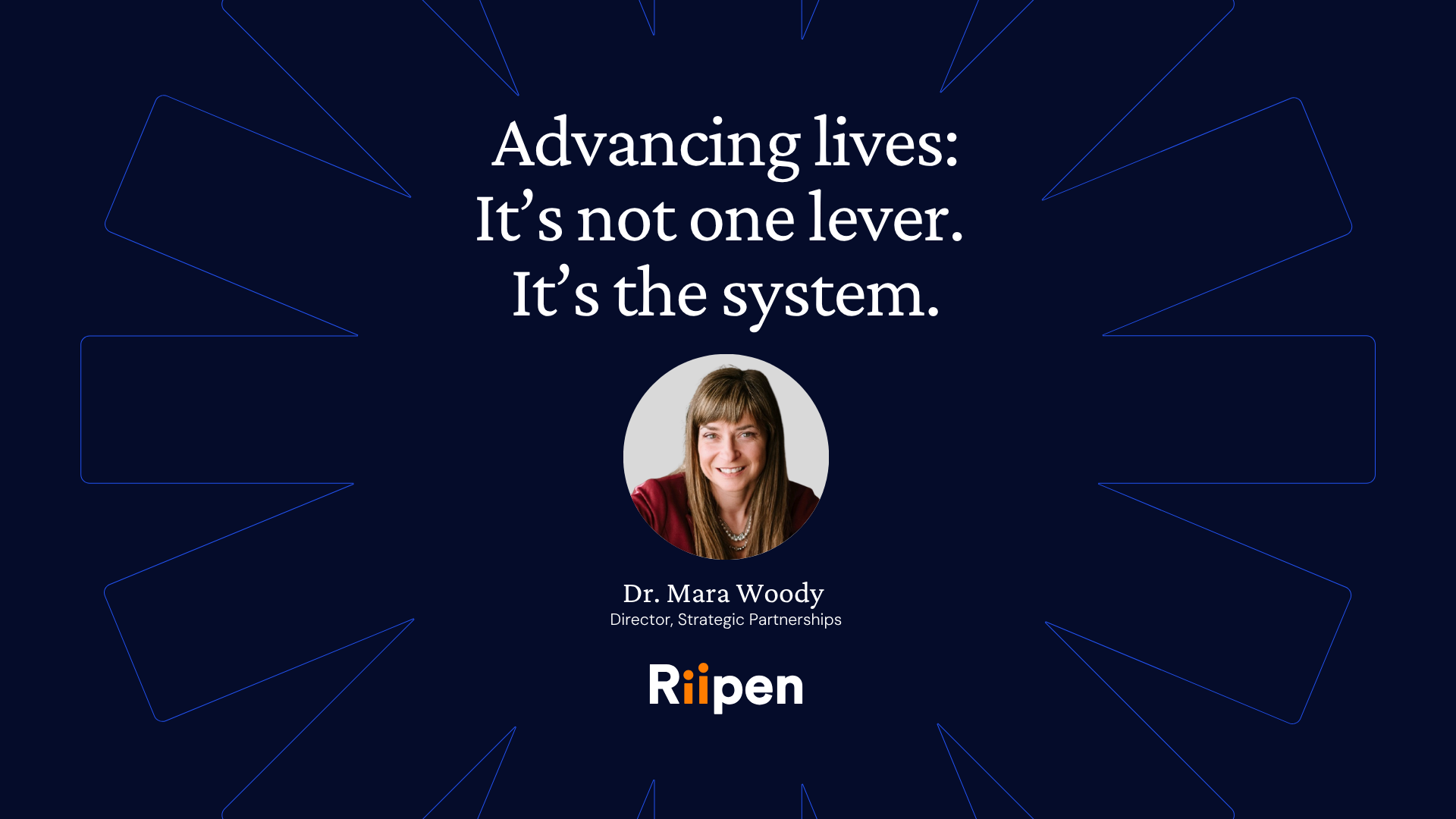


Written by Mara Woody, Director of Strategic Partnerships, US Ecosystem at Riipen, this perspective draws from both lived experience and extensive work with higher education institutions. Mara partners with colleges, universities, and workforce organizations to expand access to experiential learning and career-connected opportunities. This final piece of our six-part blog series sees Mara's insights help academic leaders better understand the systemic barriers learners face and how institutions, partners, and states can design more inclusive, scalable pathways to student success.
Over the past several pieces, I’ve explored three of the most powerful levers states have to transform education and workforce systems:
- Convening
- Financial policy
- Statutory policy
Each one matters. Each one can drive meaningful change. But if there is one lesson that has become clear through my work, it is this:
No single lever transforms a system on its own.
We often approach change by focusing on one tool at a time. We convene partners and build alignment, invest funding in new programs, and pass policies that set new expectations. Each of these efforts can create progress.
But on their own, they rarely create lasting change. Systems do not shift through isolated actions; they shift when these levers work together. I have seen this firsthand. I have seen alignment built through convening, only to stall because there was no funding to sustain the work. I have seen funding invested into promising initiatives that struggled because institutions and employers were not aligned around a shared goal. And I have seen policy introduced with strong intent that became compliance-driven because the relationships and infrastructure needed to support it were not in place.
This is where the work becomes more complex and more important. Transformation happens when these levers are intentionally aligned. When convening is used to build trust and shared purpose, when financial policy reinforces that purpose with real capacity, and when statutory policy embeds that purpose into the system's structure.
When that alignment happens, efforts stop competing and start reinforcing each other. Institutions, employers, and partners begin to move in the same direction. What once required constant effort begins to function as part of the system itself.
This is what I think about when I think about enablement. Not as a single action, but as a coordinated system of support. Through the lens of the ADVE Framework, this is where everything comes together.
Alignment ensures that we are solving for the same outcomes. Design ensures that learning and experience are built together in ways that reflect real-world application. Validation ensures that we understand what is working and can adapt over time. And enablement, when done well, is the integration of these levers. It is what allows systems to carry the work forward.
There is something even more fundamental underneath all of this that no policy or funding model can create on its own.
Trust.
Trust is what allows institutions to partner differently, what allows employers to engage more deeply, and what allows systems to take risks, test new models, and move beyond the familiar.
Trust is built through community.
People working together over time with shared goals, language, and accountability. This is why convening is so often where this work begins. Not because it is the only lever, but because it is where relationships form. And without those relationships, the other levers struggle to take hold.
When we get this right, we move beyond fragmented efforts and isolated programs. We begin to build ecosystems. Ecosystems where:
- Learning is connected to real-world applications.
- Skills are visible and trusted.
- Employers are active partners.
- Learners have access to meaningful opportunities.
This is what it will take to truly scale work-based learning. Not more pilots or one-off partnerships, but systems that are intentionally designed to deliver these experiences at scale.
We are at a moment where we have more alignment than ever around what needs to change. We have more data than ever about what works. And we have more examples than ever of systems beginning to move in the right direction.
The opportunity in front of us is not to continue experimenting at the edges, but to bring these pieces together and align the levers we already have. To build systems that are capable of delivering on the promise we have made to learners.
At the end of the day, this work is not about policy or programs. It is about whether education can do what it is meant to do: advance someone’s life. That only happens when the system is designed to make it possible.
About the author:

Dr. Mara Woody, Ed.D., is an award-winning leader, nationally in-demand speaker, and a leading national voice on transforming higher education for a rapidly evolving workforce. With over two decades of experience across public policy, academic affairs, and workforce development, she is known for turning bold ideas into scalable, system-wide impact. As Director of Strategic Partnerships at Riipen, she brings together educators, employers, and policymakers to expand access to real-world learning and advance responsible AI-enabled education. Previously serving as Missouri’s Assistant Commissioner for Postsecondary Policy, she led statewide initiatives to redesign systems around learner success. Dr. Woody, who holds a doctorate from Vanderbilt University, is dedicated to building collaborative, education ecosystems that expand opportunity and drive meaningful outcomes.


You may also like


%20for%20Webflow.png)


