Advancing lives: From alignment to action.
This blog explores why meaningful systems change depends on more than alignment and strong ideas. It examines the role of ecosystem infrastructure, state leadership, and intentional convening in scaling experiential learning, highlighting how trust, collaboration, and sustained partnerships help move work-based learning from isolated efforts to lasting, system-wide impact.
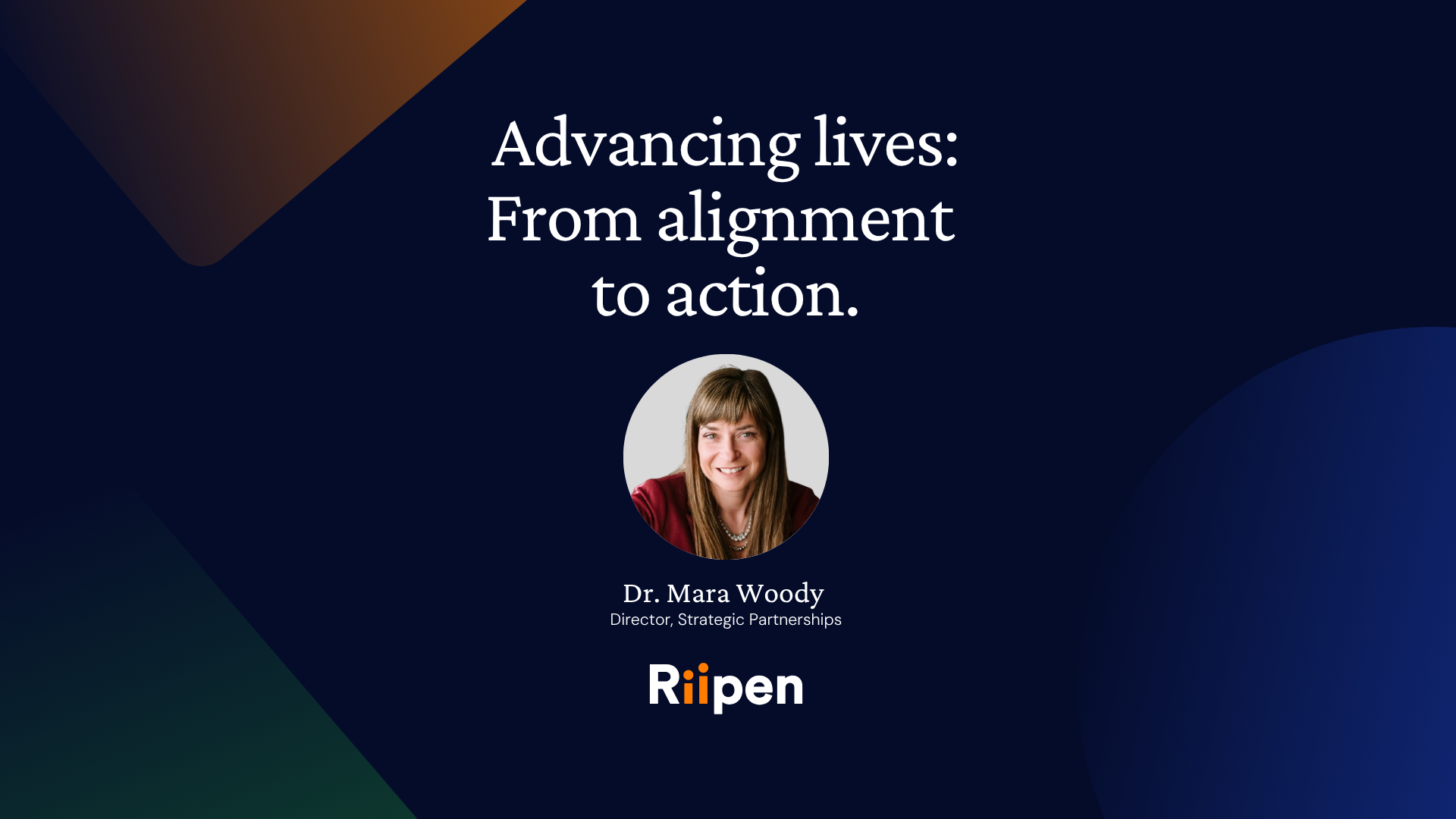


Written by Mara Woody, Director of Strategic Partnerships, US Ecosystem at Riipen, this perspective draws from both lived experience and extensive work with higher education institutions. Mara partners with colleges, universities, and workforce organizations to expand access to experiential learning and career-connected opportunities. Part three of a six-part blog series sees Mara's insights help academic leaders better understand the systemic barriers learners face and how institutions, partners, and states can design more inclusive, scalable pathways to student success.
In my last piece, I shared one of the moments that shaped how I think about education and the work that followed. I wrote about systems that were not designed for real lives, the limits of traditional credentials, and the need to rethink how learning, skills, and experience connect.
I also introduced the ADVE Framework as a reflection of what I have seen work in practice. Align, Design, Validate, Enable.
But there is a question that comes up every time I share this work. What does it actually take to make this real at scale? While it is the critical infrastructure, alignment is not the only challenge. We can get people in a room. We can agree on the problem. We can even co-design strong solutions.
The challenge is what happens next.
I have seen this play out more times than I can count: a group aligns around a shared goal. There is energy. There is momentum. There is a clear path forward. Then the work stalls. Not because the idea was wrong. But because the system was never enabled to carry it forward.
This is where most efforts break down. We underestimate what it takes to turn good ideas into sustained change. And we treat enablement and the necessary infrastructure as an afterthought, when in reality, they determine whether anything lasts. This is where I have come to believe the most important work sits today.
Having the opportunity to serve in a state public service role, I have been able to connect ecosystem-building from several perspectives. And I want to highlight how states may play a critical role in building, sustaining, and scaling ecosystems. From my experience working in state government and now building ecosystems through Riipen, there are three primary levers states have that shape whether systems change actually takes hold:
- Financial
- Statutory
- Convening
All three matter. But convening is often the most misunderstood and most underutilized.
When most people think about convening, they think of meetings: probably boring, information-sharing, updates that involve only half the group, and possibly some coordination. We may be present in the room, but are most likely checking our email for most of the meeting. This is not what drives change. What drives change is convening with intention - bringing people together not to talk about the work, but to build community and do the work together.
I saw this clearly in Missouri.
When we launched the Adult Learner Network, the goal was not to create another initiative. It was to create a space where institutions, workforce leaders, and community organizations could align around a shared challenge and stay connected long enough to act on it.
The power was not in the meeting, but in the continuity: the relationships, shared language, and trust that were built over time. That is what allowed the work to move.
I saw it again in Student Journey Mapping. The workshop itself was important, but it was not the outcome. The outcome was that institutions were left with a different way of working. A way to center the learner voice, rally together around a shared goal, test assumptions, and continue redesigning their systems long after the convening ended. This is what enablement looks like in practice. It is not an event, but a shift in how work gets done.
This same principle is at the core of how we approach this work at Riipen. To be serious about scaling work-based learning means we cannot rely on one-off partnerships or isolated programs. We need infrastructure.
Riipen is designed as an ecosystem-enabling architecture that connects institutions, employers, public and community organizations, and partners to create access to industry-authentic projects at scale. Our technology platform is actually only a small part of the story. What makes the work move is the ecosystem built around it.
Through consortia, ecosystems, and communities of practice, we bring institutions, employers, and partners into sustained collaboration. Not to observe, but to build, share what is working, solve problems together, and refine models in real time. This is where alignment turns into design, and it is continuously validated. Those insights are then carried forward and scaled.
One of the biggest misconceptions about work-based learning is that it fails to scale because we lack opportunities. That there is not enough supply from employers and industry to create opportunities for all learners.
That is not the issue.
Work-based learning does not scale because we lack alignment and trust. Without alignment, efforts remain fragmented. Without trust, partners do not take the risks required to build something new. Without both, systems revert to what is familiar.
This is why community is not a secondary consideration in this work. It is the infrastructure that allows systems to move from intention to action.
And this is where the role of state leadership becomes even more critical. States are uniquely positioned to do something no single institution or organization can do on its own. They can align these levers, convene ecosystems, direct resources, and remove barriers. When those levers are aligned with a clear goal and a strong ecosystem, the pace of change accelerates.
We are at a moment where we cannot afford to get this wrong. The data is clear. Access to experiential learning drives outcomes. It shapes opportunity. It influences mobility.
And yet, millions of learners still lack access to these experiences. Not because we do not know what works. But we have not built systems that can deliver it at scale. This is not a knowledge gap. It is a gap in execution.
The work ahead is not about adding more programs. It is about building ecosystems that make this work sustainable, aligning the levers that enable systems to move, and committing to the kind of collaboration that builds trust over time.
In the next part of this series, I will go deeper into examples of how states are using financial and statutory levers to reinforce this work and expand access to work-based learning in meaningful ways.
If convening is where alignment begins, these levers are what allow it to scale.
We know what works.
The question now is whether we are willing to build the systems that can deliver it.
About the author:

Dr. Mara Woody, Ed.D., is an award-winning leader, nationally in-demand speaker, and a leading national voice on transforming higher education for a rapidly evolving workforce. With over two decades of experience across public policy, academic affairs, and workforce development, she is known for turning bold ideas into scalable, system-wide impact. As Director of Strategic Partnerships at Riipen, she brings together educators, employers, and policymakers to expand access to real-world learning and advance responsible AI-enabled education. Previously serving as Missouri’s Assistant Commissioner for Postsecondary Policy, she led statewide initiatives to redesign systems around learner success. Dr. Woody, who holds a doctorate from Vanderbilt University, is dedicated to building collaborative, education ecosystems that expand opportunity and drive meaningful outcomes.


You may also like