Advancing lives: Building systems through alignment and community.
This blog explores how meaningful systems change happens through collaboration, shared goals, and learner-centered design. Drawing on real initiatives across higher education and workforce development, it introduces the ADVE Framework, a practical model for redesigning systems to expand opportunity, validate learning, and create scalable pathways that better support learners.
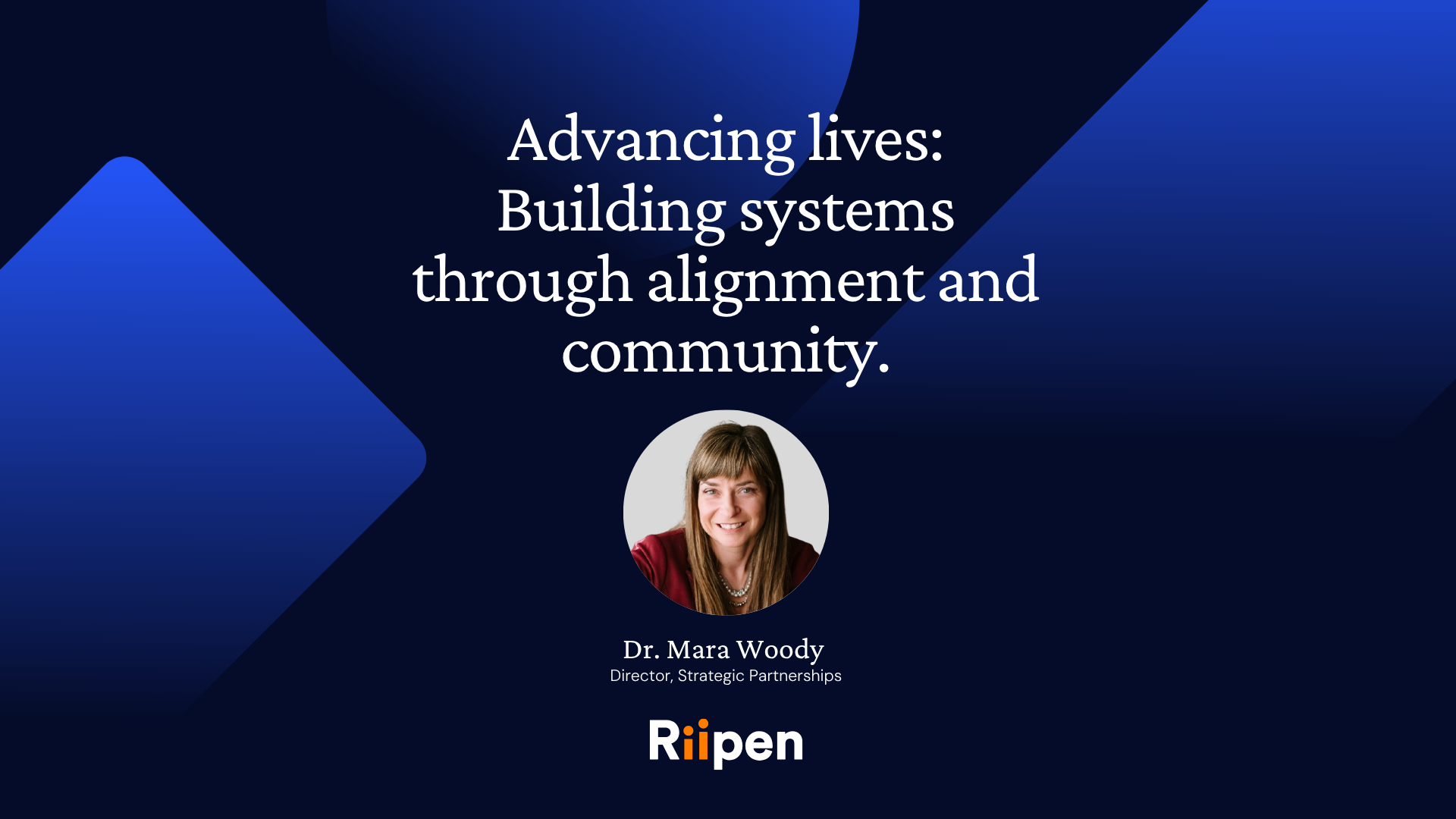


Written by Mara Woody, Director of Strategic Partnerships, US Ecosystem at Riipen, this perspective draws from both lived experience and extensive work with higher education institutions. Mara partners with colleges, universities, and workforce organizations to expand access to experiential learning and career-connected opportunities. Part two of a six-part blog series sees Mara's insights help academic leaders better understand the systemic barriers learners face and how institutions, partners, and states can design more inclusive, scalable pathways to student success.
In my last piece, I wrote about the moment I realized the system was not designed for my life, and why so many efforts to improve outcomes fall short. The question that follows is a practical one.
If this is a systems problem, how do we actually change the system?
What I have learned through my work is that systems do not change in isolation. They change when people come together around a shared goal, design solutions together, learn from what is working, and build the conditions to scale it.
This is the work I have led.
In Missouri, I led the development of the Adult Learner Network to address a clear gap in our attainment strategy. Traditional-aged students alone would not get us to our goal. We needed to build a system that engaged adult learners in meaningful ways. We did not build a program. We built a community. A network that brought institutions, workforce leaders, and community organizations into alignment around a shared purpose and created the space to design and implement solutions together.
I led the development of Student Journey Mapping workshops to center the learner voice in system design. Institutions faced real challenges and worked through them by drawing on learners' lived experiences and by ensuring full participation. This was not theoretical. It was practical, applied, and designed to continue beyond the workshop itself. We studied the outcomes, refined the approach, and scaled what worked.
More recently, I co-developed the AI Readiness Consortium with Complete College America to address what I see as the next major divide. Access to AI is not just about technology. It is about opportunity. Without intentional design, those with resources will move forward, and those without will fall further behind. Through cross-sector collaboration and project-based learning, we are creating pathways for all learners to build real skills and engage in the future of work.
Across all of this work, a consistent pattern emerged. Not as theory, but as practice. That is what I now define as the ADVE Framework: Align, Design, Validate, Enable.
Alignment establishes shared goals across systems, critical to building the trust and community needed in every ecosystem.
Design builds learning and experience together with partners to create programs that serve everyone, not just a select few.
Validation creates the feedback loops within the ecosystem that make learning visible and trusted.
Enablement builds the policies, infrastructure, and conditions, as well as resources needed, to scale what works.
The most important lesson that sits underneath all of this is that none of it works without community.
Community is not a byproduct of this work. It is the infrastructure that architects the ecosystem. Trust is not created through frameworks. It is built through people working together toward a shared goal, consistently and intentionally. When that trust is established, systems begin to move. Silos break down. Opportunities expand. Everyone works together. And learners gain access to pathways that were not previously available to them.
This is the work ahead. Not incremental change, but intentional redesign. Not isolated efforts, but aligned ecosystems. Not assumptions, but validated learning.
I am committed to leading this work.
And I am building with partners who are ready to move beyond conversation and into action.
If you are working to redesign systems, expand opportunity, and build something that truly advances learners’ lives, there is a place for you in this work.
This transformation will not happen alone.
But it will happen together.
About the author:

Dr. Mara Woody, Ed.D., is an award-winning leader, nationally in-demand speaker, and a leading national voice on transforming higher education for a rapidly evolving workforce. With over two decades of experience across public policy, academic affairs, and workforce development, she is known for turning bold ideas into scalable, system-wide impact. As Director of Strategic Partnerships at Riipen, she brings together educators, employers, and policymakers to expand access to real-world learning and advance responsible AI-enabled education. Previously serving as Missouri’s Assistant Commissioner for Postsecondary Policy, she led statewide initiatives to redesign systems around learner success. Dr. Woody, who holds a doctorate from Vanderbilt University, is dedicated to building collaborative, education ecosystems that expand opportunity and drive meaningful outcomes.


You may also like