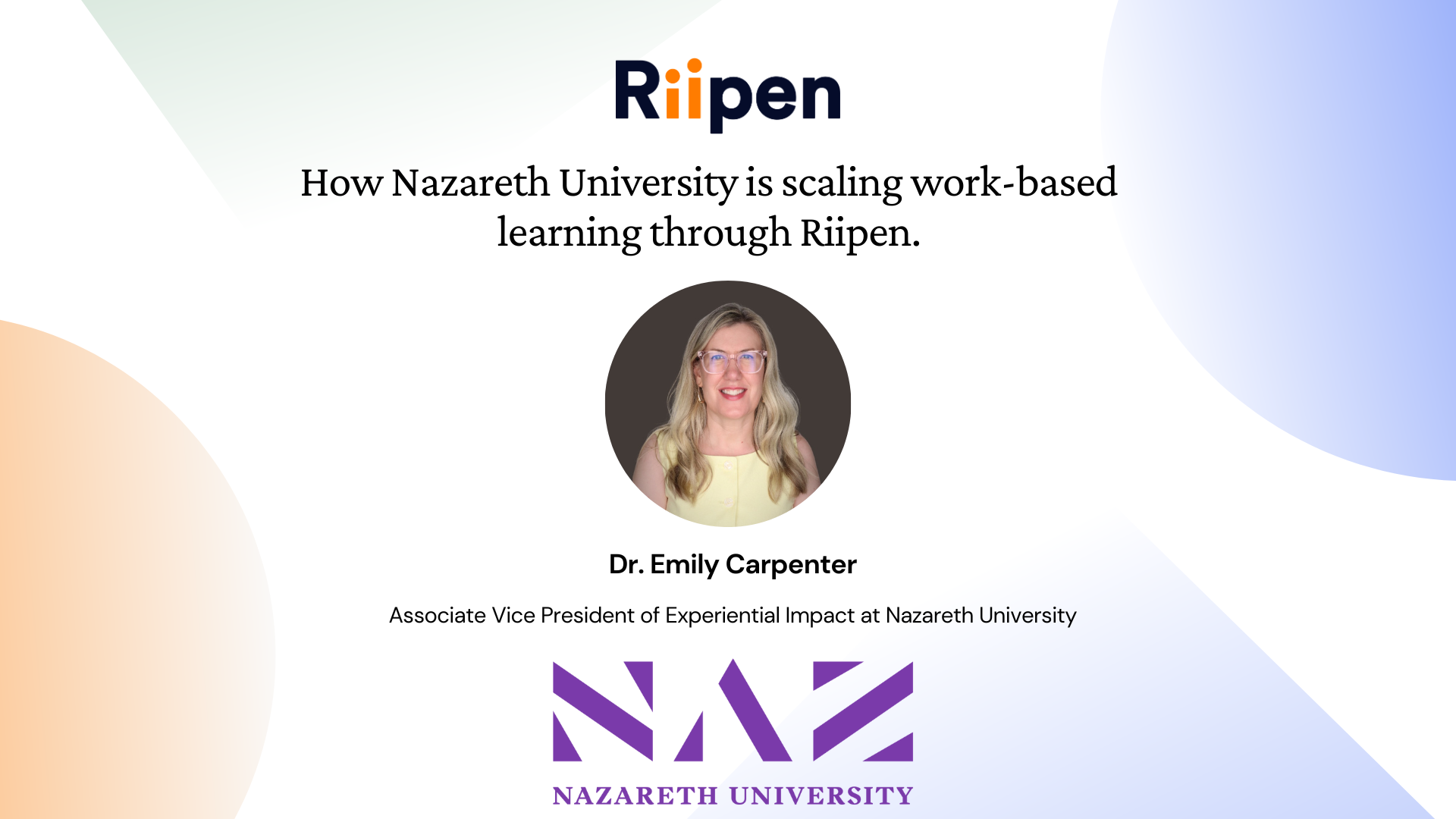
How Nazareth University is scaling work-based learning through Riipen.
Dr. Emily Carpenter, Associate VP of Experiential Impact at Nazareth University, shares how integrating work-based learning directly into coursework is expanding access and improving student career readiness. Through Riipen, Nazareth is building scalable, equitable experiential learning pathways that meet students across disciplines and schedules, while supporting faculty and strengthening employer connections.


Designing experiential learning that works for every student.
For many students, experiential learning is the key to bridging the gap between understanding theory and applying it in practice. Yet access to meaningful, work-based experiences remains uneven, shaped by factors such as schedules, finances, geography, and academic discipline. At Nazareth University, closing that gap has become a strategic priority.
Dr. Emily Carpenter, Associate Vice President of Experiential Impact at Nazareth University, has spent more than 25 years in higher education working toward a simple, guiding question: How do institutions design experiential learning so that every student can participate, not just those with flexibility or privilege? Her work spans the career center, community engagement, study abroad, and internships, giving her a systems-level view of what it takes to make experiential learning effective at scale.
Through Nazareth’s partnership with Riipen, Dr. Carpenter and her colleagues are embedding work-based learning directly into coursework, ensuring students gain real-world experience as part of their academic journey rather than as an optional add-on.
A career shaped by access and opportunity.
Dr. Carpenter’s approach is rooted in both professional experience and personal history. Growing up in a rural community with parents who met at community college, she saw early on how access to education shapes opportunity. After beginning her career in finance, she pivoted toward counseling and discovered a passion for higher education during an internship at the University of Rochester, where she later spent 12 years.
After moving to Nazareth University, she pursued her doctorate to work at a broader organizational level, focusing on how institutions design systems that support student success. Today, her role centers on building the structures faculty and staff need to deliver experiential learning effectively across programs.
The "three A's" of experiential learning.
Dr. Carpenter frames her vision for experiential learning around what she calls the "three A's": Affordability, accessibility, and availability.
Affordability means experiential learning should not depend on a student's financial means.
Accessibility means institutions find creative ways to provide transportation for students.
Availability means opportunities must fit into varied schedules and academic requirements.
Rather than asking students to take on additional commitments, Nazareth integrates work-based learning directly into courses. This makes experiential learning "structurally unavoidable" and ensures participation across disciplines, from performing arts to accounting to health services.
This approach also addresses a challenge many students face early in their careers. As Dr. Carpenter notes, "You often don't know what you like until you're doing it." Work-based learning enables students to test-drive career paths, confirm their interests, or redirect their focus early, before graduation.
Why Riipen became the right partner.
Nazareth’s partnership with Riipen began through a CIC grant focused on aligning workplace learning with liberal arts education. For a small private institution with limited discretionary funding, the grant created an opportunity to pilot and scale work-based learning in ways that might not have been possible otherwise. While Nazareth requires each student to complete at least one experiential learning opportunity before graduation, students currently average 3.6 experiences, reflecting both strong student demand and institutional commitment to applied learning.
Dr. Carpenter was already familiar with Riipen through experiential education conferences. The partnership provided an opportunity to test a structured, supported approach to employer-connected projects while minimizing the administrative burden on faculty. By reducing the administrative burden on faculty and coordinators, Riipen made it easier to embed employer-connected projects directly into coursework, supporting students who consistently exceed the minimum requirements.
Riipen’s platform and support made it easier to source projects, manage communication, and connect students with employers across North America, regardless of Nazareth’s geographic location. This expanded the range of industries and opportunities available to students beyond what even strong local partnerships could provide.
Supporting faculty through structure and community.
One of the partnership's most important impacts has been on faculty engagement. Rather than positioning work-based learning as additional work, Nazareth paired Riipen's training and support with faculty stipends and a growing community of practice.
Faculty champions mentor peers, share examples, and help normalize experiential learning across departments. This peer-to-peer model has been critical in driving adoption and sustaining momentum.
By reducing friction and providing consistent support, Riipen has helped faculty integrate real-world projects into their courses without overwhelming existing workloads.
Student impact that goes beyond the classroom.
The value of this approach is visible in student outcomes. One example Dr. Carpenter highlights involves an education major who completed a Riipen project in a history class, writing a blog post for an online travel company. The experience complemented traditional student teaching and gave the student a tangible example of applied skills to share with employers.
Across programs, students report greater confidence, stronger communication skills, and clearer connections between their academic work and career goals. Employers, in turn, benefit from fresh perspectives and motivated contributors who are supported by faculty and Riipen’s structure.
Looking ahead.
As Nazareth approaches the end of its initial three-year partnership, the focus is on growth and sustainability. Dr. Carpenter sees opportunities to expand work-based learning into honors projects and community engagement programs, while continuing to prioritize classroom integration as the most equitable approach.
The long-term goal is ambitious and clear: for every student to have multiple, discipline-specific opportunities to experience what work looks like in their field, across different industries and contexts.
Through Riipen, Nazareth University is building toward that future deliberately, with systems designed to support faculty, expand access, and ensure experiential learning delivers real value for students.
Get started with Riipen today!

About the author:
Jasmine Roberts leads the content team at Riipen as the Senior Manager of Brand and Content Marketing. With a passion for writing, Jasmine has written for over 10 Canadian publications, including ELLE Canada, Collider, Later, and more. With a love of education and higher learning, Jasmine is proud of the work Riipen does to help learners gain real-world experience to prepare for their careers.


You may also like